Dynamics of a Particle
Dynamics of a Particle
As we have seen in chapter [chap_phys:kinematics_of_a_particle kinematics of a particle], knowing the acceleration of a body, we can derive its equation of motion1 solving one (or more) differential equation. Doing kinematics we are however not asked why a body moves; we only describe its motion.
In this chapter we investigate the causes that make bodies move. We will then introduce forces and energy and understand how they are bound to the motion of a body. Dynamics, using the concepts of mass, momentum, and force, is the foundation of classical mechanics.
The Mass
Definition of Mass
In common language, the terms mass and weight are interchangeable. In physics, however, these two words have profoundly different meanings.
a) Weight is a force (hence a vector!), that a body exerts, for example, on the floor. The weight is what we measure with a scale.
b) Mass is an intrinsic property (scalar) of a body. It is a measure of how much "matter" is contained in a body.
Weight can vary depending on the circumstances; for example, the weight of an astronaut will be different on Earth compared to in orbit around the Earth (where the measured weight will be zero). Mass, on the other hand, does not vary between Earth and orbit2.
Inertial mass and gravitational mass
There are several experiments we can conduct to measure the mass of a body. One possibility is to measure how the velocity of carts on an air track changes based on their mass. Another way is to use a scale to measure with how much force a body "pushes" downward, and derive the mass from there. We distinguish between these two types of mass.
a) Inertial mass is the quantity we measure with a collision experiment between carts. It is a measure of how difficult it is to accelerate an object.
b) Gravitational mass is the quantity we measure with a scale. It is the property that "generates" gravitational attraction.
Although the two definitions are different, various experiments lead to the conclusion that these two types of mass are actually identical. The explanation for this lies in Einstein’s theory of general relativity, which, however, will not be covered in this chapter.
Inertial mass and gravitational mass are equal.
Momentum
Conducting the experiment discussed, where we make carts with different masses collide, we obtain the following empirical relation:
\[\begin{equation} \frac{m_A}{m_B} = \frac{v_B}{v_A} \implies m_Av_A = m_Bv_B \label{eq:conservation_of_momentum} \end{equation}\]
Ordering quantities in this way we notice that \(m_Av_A\) and \(m_Bv_B\) are properties of carts A and B, respectively.
We then define a new quantity:
Linear momentum is defined as the product between mass and velocity. \[\begin{equation} \vb{p} = m\vb{v} \label{eq:momentum} \end{equation}\]
Momentum is a vector quantity, as it is defined through velocity, which is also a vector.
The conservation of momentum
The general law
We have seen how in the collision experiment between carts, once the first cart has struck the other, all the momentum is transferred from the first to the second cart. [Conservation of momentum]. We can then derive the following equation:
\[\begin{equation} \vb{p}_{tot}(initial) = \vb{p}_{tot}(final) \end{equation}\]
The law of conservation of momentum is generally valid, and we can formulate it in the following way:
An isolated system is defined as a system that does not interact in any way with other bodies. The system may be far removed from other bodies, or the interactions with other bodies cancel each other out, eliminating their effect.
In an isolated system, the total momentum is conserved.
Consider now an isolated system of \(N\) particles. The total momentum of the system is given by the following:
\[\begin{equation} \vb{p}_{tot} = \sum_{i = 1}^{N}\vb{p}_i \end{equation}\]
Then we find that \(\vb{p}_{tot}\) is conserved (magnitude and direction).
What happens, however, if the system interacts with other bodies, and therefore momentum is not conserved?
The Second Newton’s Law: The Action Principle
The resultant force acting on a body is equal to the time rate of change of the momentum of said body.
\[\begin{equation} \label{eq:second_newtons_law} \vb{F} = \dv{\vb{p}}{t} \end{equation}\]
This is not a definition of force; it is merely a heuristic relation3 between the change in momentum and force.
Relation between force and acceleration
We can use the definition of momentum to rewrite the equation [second newton's law] in terms of mass and velocity:
\[\begin{equation} \vb{F} = \dv{\vb{p}}{t} = \dv{}{t}[m\vb{v}(t)] = m \dv{\vb{v}(t)}{t} = m \vb{a}(t) \end{equation}\]
It follows immediately the principle of action:
The acceleration of a body, whose mass does not change over time, is inversely proportional to its mass and directly proportional to the resultant force acting on the body.
\[\begin{equation} \vb{a}(t) = \frac{1}{m} \sum_{i = 1}^{n}\vb{F}_i \end{equation}\]
Since mass is a scalar, acceleration and the resultant force are always directed in the same direction.
Unit of measurement: In the International System, the unit of measurement for force is the Newton (N), which represents the force necessary to accelerate a body of one kilogram by one meter per second squared:
\[\begin{equation} 1 [N] = 1 [Kg/(m/s^2)] \end{equation}\]
The first Newton’s law: the principle of inertia
In the case where the resultant force on a body is equal to zero, then the conservation of momentum holds:
\[\begin{equation} \dv{\vb{p}}{t} = 0 \iff \dv{\vb{v}}{t} = 0 \iff \vb{v} = cost. \end{equation}\]
If no forces act on a body (or the resultant is zero), the body remains at rest or continues to move at a constant velocity.
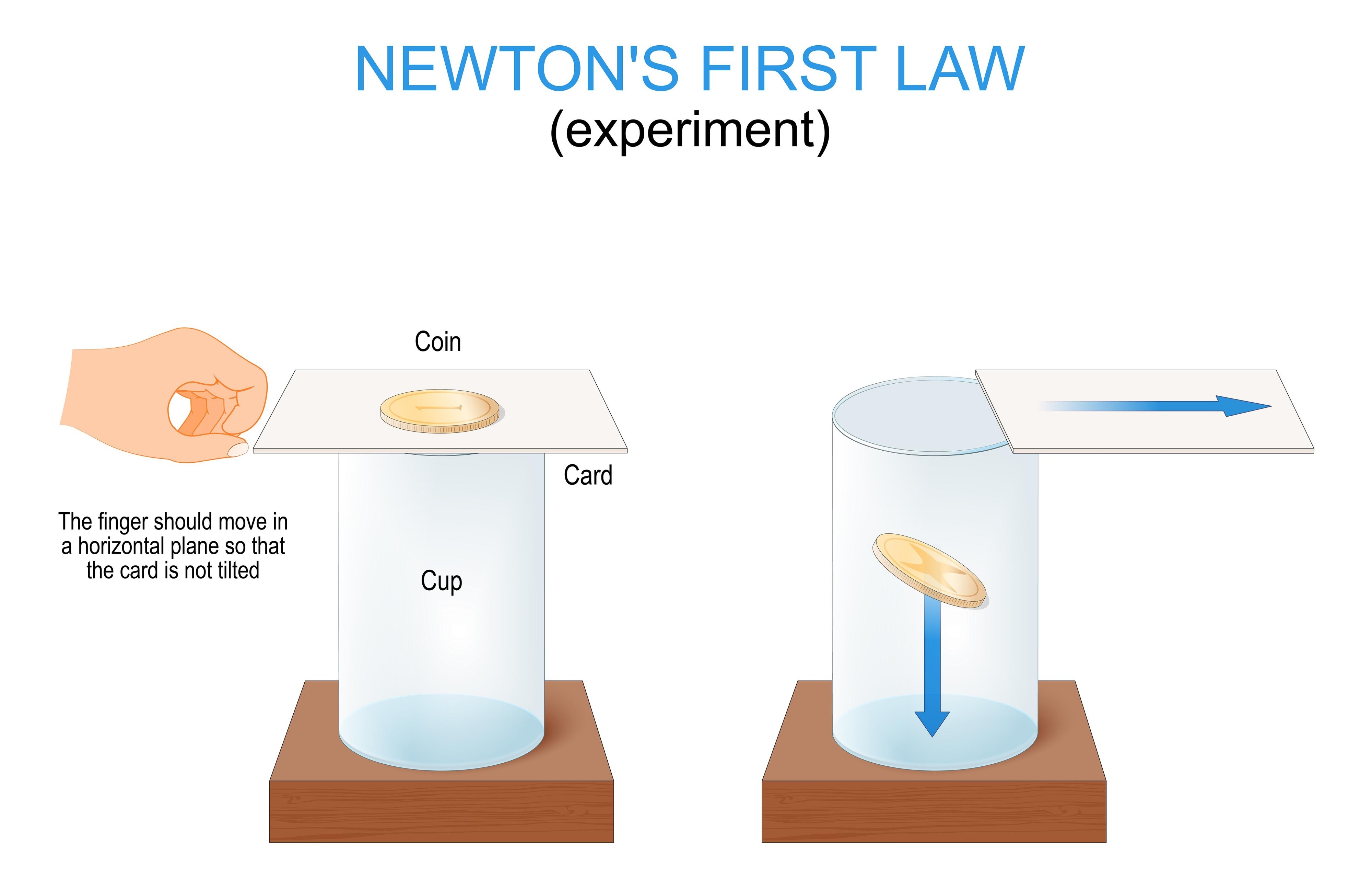
From this law, it follows the definition of inertial reference frame:
An inertial reference frame is a system in which Newton’s first law holds. In other words, it is a system in which a body on which no forces act remains at rest or moves at a constant velocity.
Accelerated reference frames, such as rotating ones, are not inertial reference frames; in fact, in these types of systems, apparent forces act, due to the acceleration of the system, which contradict Newton’s first law.
The Third Newton’s Law: Actio-Reactio Principle
Every body on which a force acts exerts an equal and opposite force.
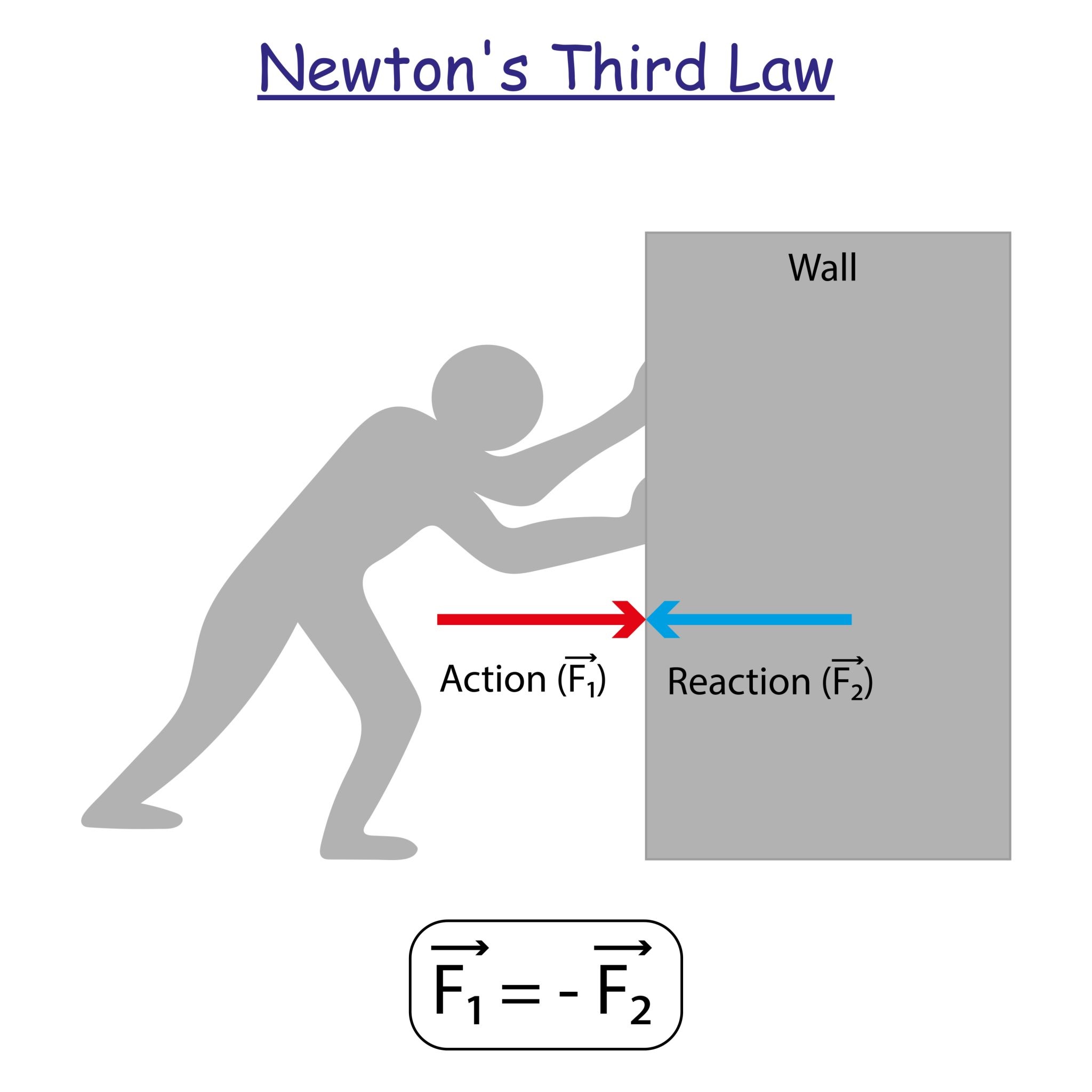
This law also follows directly from the principle of action [second newton's law]. Consider two bodies A and B in an isolated system. Since the system is isolated, the conservation of momentum must hold:
\[\begin{equation} \dv{\vb{p}_{tot}}{t} = \dv{\vb{p}_A}{t} + \dv{\vb{p}_B}{t} = 0 \end{equation}\]
From Newton’s second law it follows:
\[\begin{equation} \vb{F}_A + \vb{F}_B = 0 \iff \vb{F}_A = -\vb{F}_B : \text{Action = Reaction} \end{equation}\]
Application of Newton’s laws
Newton’s laws allow us to solve practically any problem of classical physics. The first thing to do is to choose a body whose motion we want to describe and choose a reference frame. After that, we must insert all the forces acting on the body into Newton’s second law:
\[\begin{equation} \sum_{i = 1}^{n} \vb{F}_i = m\Ddot{\vb{x}}(t) \end{equation}\]
By solving the differential equation, we will then be able to derive the equation of motion of our body!